Wolfhoeve · Beekbergen, Netherlands

Giant
Brahma
Breeding

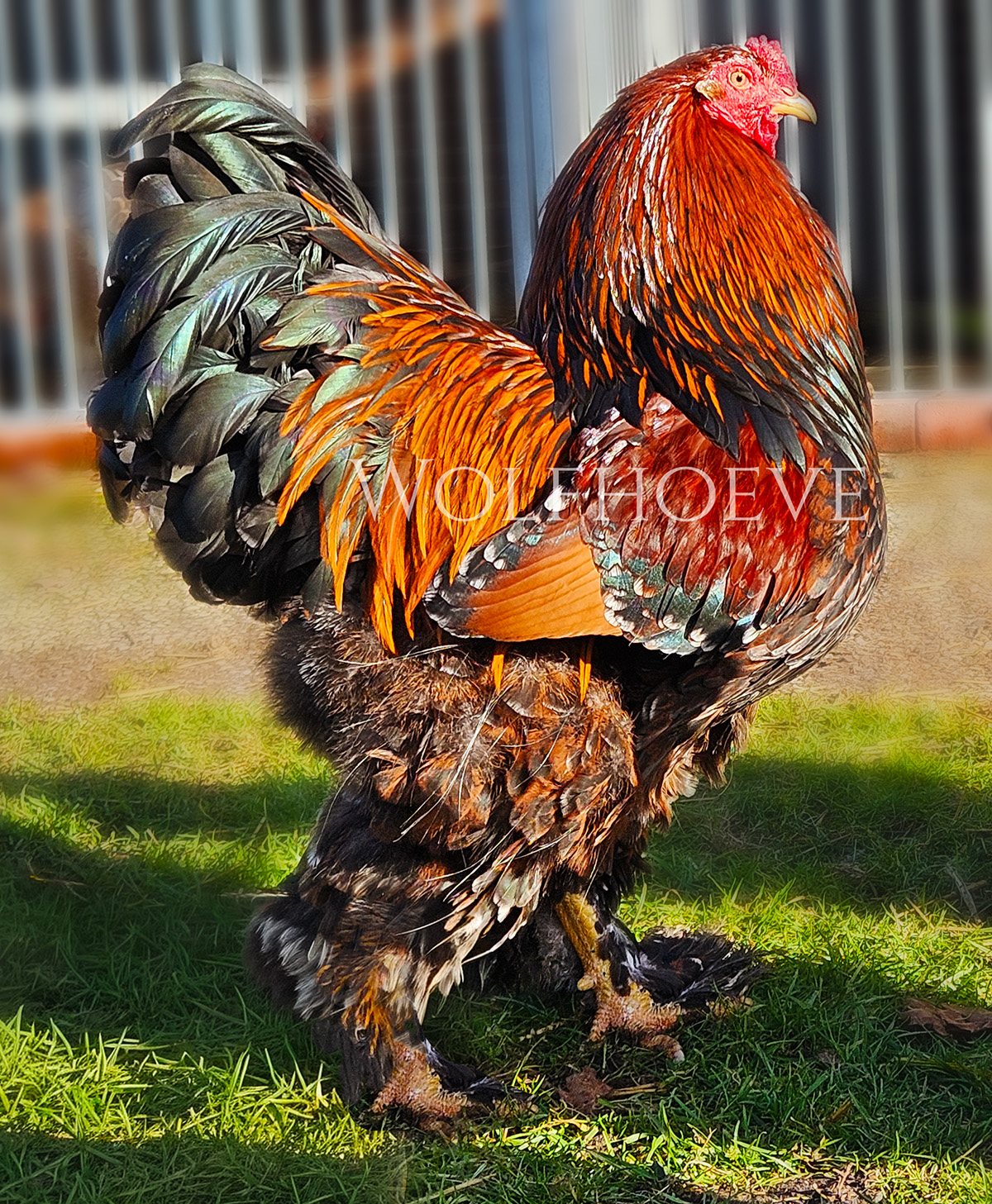
We raise giant Brahma chickens with a focus on correct type and a serious program to develop new and rare colors within the breed — some of which exist nowhere else in the world.

About Wolfhoeve

A farm built
on type

Wolfhoeve is a specialist breeding farm in Beekbergen, on the edge of the Veluwe in the Netherlands. We keep giant Brahma chickens — one of the largest and most visually striking chicken breeds in existence — and we breed them seriously.

Our work is built on two things: preserving the correct Brahma type that defines the breed, and expanding the range of colors that Brahma can come in. Some of those colors we are developing for the first time anywhere in the world.

Brahmas are also extraordinarily calm and friendly birds. They adapt well to being handled, tolerate children, and have a quiet, stately presence that makes them remarkable to keep — whether you are a serious collector or simply want something extraordinary in your backyard.

Giant
One of the world's largest breeds
Calm
Gentle temperament, great with people
Rare
Colors unavailable anywhere else
Beekbergen
Veluwe, Netherlands

Type is never compromised for color

The Brahma has a very specific silhouette, posture, and mass. Every bird we breed must be correct Brahma first. Color development takes as long as it takes — we never cut corners by accepting poor type in exchange for a faster color result.

Genetics, not guesswork

Each cross is planned from the ground up. We know the genetic makeup we are working toward, we source parent birds with confirmed genetics, and we track every generation. If something unexpected appears, we find out why before moving on.

Long-horizon thinking

Introducing a genuinely new color variety into the Brahma breed can take a decade. We plan in breeding generations, not seasons, and we share what we learn with the wider community of breeders working in the same direction.

Colors & Programs

The colors
we breed & develop

Brahmas come in a wonderful range of colors — from classic, long-established varieties to rare and unusual ones that few breeders work with. We also have active programs to develop colors that do not yet exist anywhere in the Brahma breed. Curious about the genetics behind any of these? Visit chickencolorstandards.com for a free, easy-to-use reference tool we built for exactly this purpose.
The APA officially recognizes three Brahma varieties: Light (white with black Columbian markings), Dark, and Buff. European standards recognize several additional colors including Blue Columbian, Salmon, and Gold Partridge.1
Established varieties
APA recognized
Buff (Columbian)

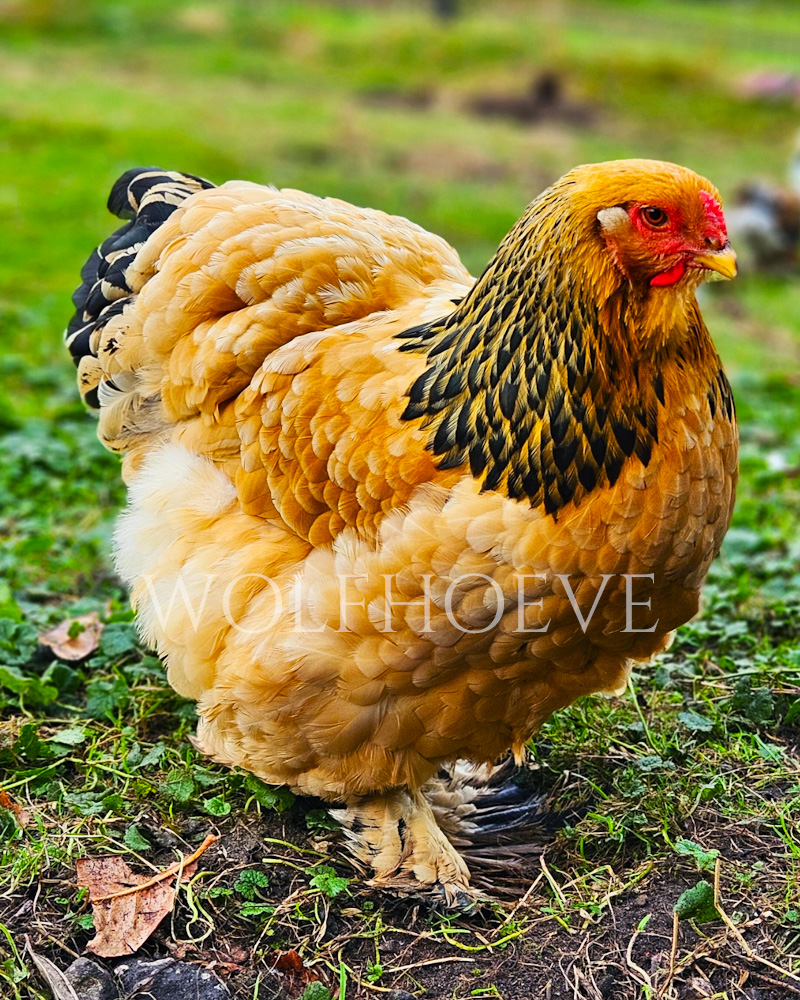
A warm golden-buff body with black shaft-stripes on the neck hackle, black tail, and black in the wing flights — buff takes the place of white in the classic Columbian pattern. One of the three APA-recognized Brahma varieties and a consistent favorite.cc

APA recognized
APA recognized
Dark

One of the original Brahma varieties, recognized since 1874. Roosters have a silvery-white hackle and saddle with black shaft-stripes, a black breast, and a white wing triangle when the wing is closed. Hens are more subtly marked: dark grey-brown body with a warm salmon breast. The two sexes look strikingly different.cc

APA recognized
APA recognized
White

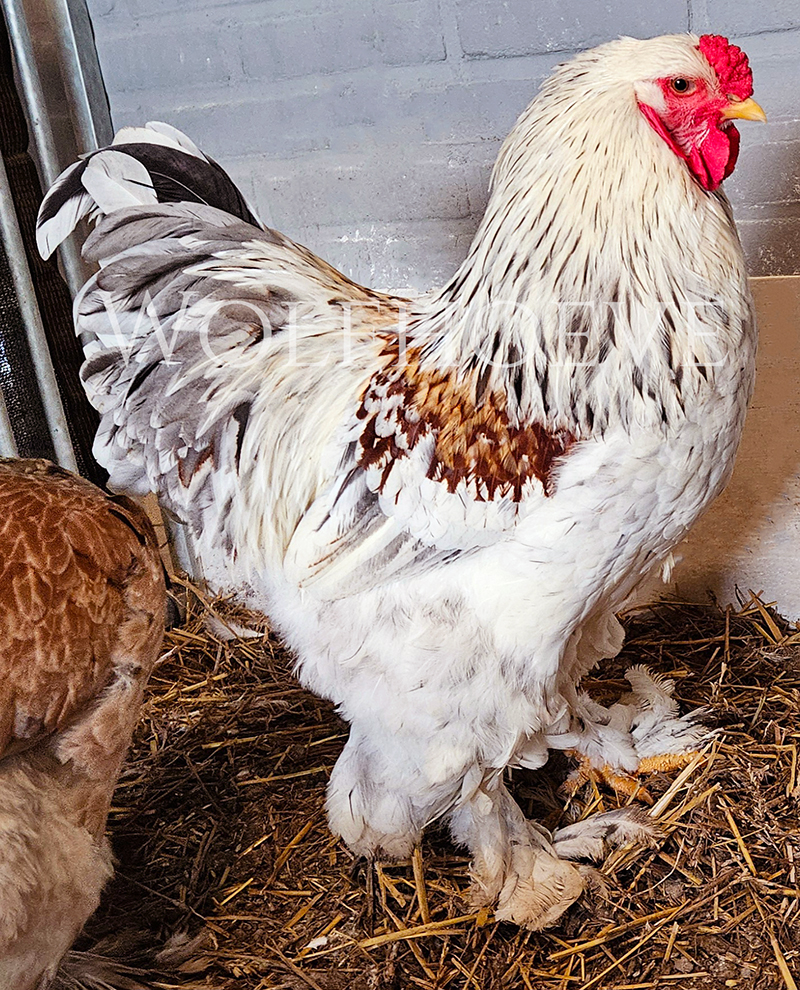
Clean, bright white throughout. On a giant Brahma — broad feathered feet, wide breast, upright posture — all-white plumage looks almost sculptural. Simple, striking, and highly visible in a mixed flock. APA recognized.

APA recognized
European standard
Blue Columbian

The buff Columbian pattern, but with the black markings softened to a cool slate-blue by a single dilution gene. The result is a gentler, cooler version of the classic pattern — still clearly structured, but in a softer palette. Recognized in several European standards.cc

European standard
Splash
Splash Columbian

Splash is what happens when two blue Columbian birds are crossed: instead of even blue, the result is an irregular, marbled pattern of white with scattered blue patches. No two splash birds look quite alike, making them particularly appealing to collectors. Always produced alongside blues in the same lines.

Splash variant
European standard
Blue Salmon

A variety with a very different look between the sexes. Hens are salmon-red with a cream beard; roosters have an ivory-yellow hackle, reddish-brown back, and a solid bright-blue body and breast. One of the more painterly Brahma color combinations, and one that photographs beautifully.cc

European standard
Splash
Splash Salmon

The splash counterpart to blue salmon — the same sex-linked salmon and ivory tones, but with irregular white and blue splashing replacing the solid blue areas. A rarer and very distinctive variation produced naturally alongside blue salmon in the same breeding lines.

Splash variant
European standard
Gold Partridge

A warm, richly marked variety. Roosters have a golden-red hackle and saddle with black striping and a black breast. Hens carry warm golden penciling on a slightly darker ground. Recognized in the British standard and bred in Europe since the 1970s.2

European standard
Established variety
Buff White Laced

A warm buff ground color with a clean white lace running around the edge of each feather. The scalloped pattern this creates across the whole bird is immediately eye-catching — layered, detailed, and unlike most other Brahma varieties.cc

Established variety
Established variety
Black Red Laced

A bold, high-contrast variety: deep red feathers with a black lace around each edge. The dark framing against a warm red ground gives the bird a jewel-like quality that is particularly striking on the broad Brahma frame.cc

Established variety
Rarer varieties bred at Wolfhoeve — less commonly seen, but fully established colors
Rare & specialty colors
Specialty
Black

Solid, deep glossy black throughout. On a giant Brahma — broad feathered feet, full breast, upright posture — the effect is strikingly regal. A variety that shows the Brahma's size and shape to full effect.

Specialty
Specialty
Blue

An even, soft slate-blue throughout — the result of a gene that dilutes black to a cool blue-grey. Individual birds vary slightly in shade, and the color develops fully as the bird matures. Beautifully complemented by the Brahma's feathered feet and heavy frame.

Specialty
Specialty
Lavender Mottled

A pale grey-lilac base (lavender dilutes all black to a soft, dusty grey) with a white mottle tipping each feather. The combination of lavender base and white-tipped mottling gives an extraordinarily delicate, layered effect unlike anything else in Brahma.cc

Specialty
Specialty
Isabel Partridge

The partridge penciling pattern on a lavender-diluted base: instead of dark brown penciling, the markings appear in soft grey-purple tones on a pale straw ground. Also called lavender double-penciled. Exceptionally rare in any breed.cc

Specialty
Colors being developed at Wolfhoeve — these varieties do not currently exist anywhere in the Brahma breed
New colors in development

What "in development" means: These varieties do not yet exist in the Brahma breed anywhere in the world. Introducing a color that requires genetics not currently present in a breed is a multi-year process. Birds from these programs are available at certain stages — contact us to ask about current availability.

In development
Buff Mottled

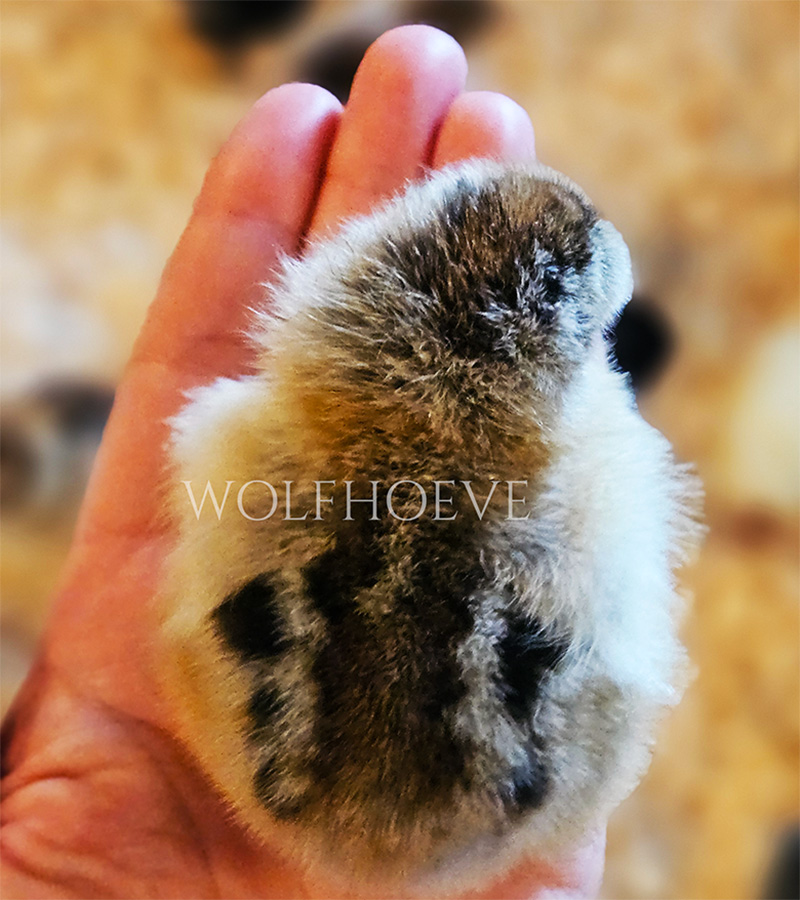
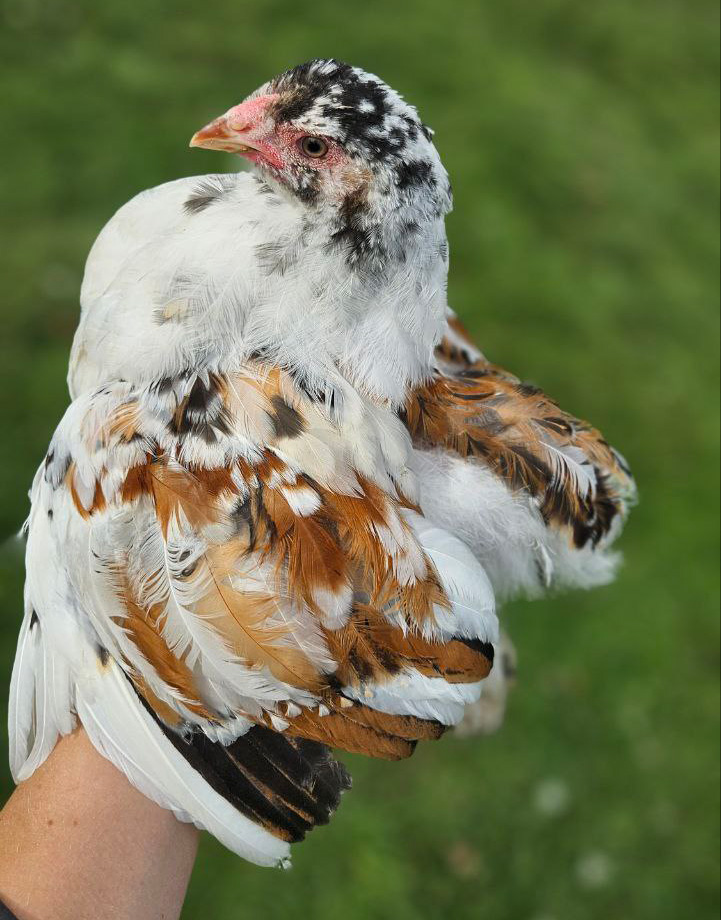
The buff Columbian pattern with white mottling added: each feather ends in a clean white spot, giving the warm golden bird a spangled, jeweled quality the standard buff Columbian does not have. A new Brahma variety we are establishing at Wolfhoeve.cc

In development
In development
Mille Fleur

French for "a thousand flowers" — each feather has a warm ocher-brown ground, a green-glossy black spangle, and a white mottle at the tip. The pattern typically improves with age; two-year-old birds often show it at its best. This color is well established in several smaller breeds, but has never existed in Brahma. We are the first to develop it in the breed.cc · ccs

First in Brahma
In development
Porcelain

Mille fleur with lavender dilution added: the black spangles soften to pale lilac-grey and the warm ocher ground lightens to a soft straw. The white mottling remains. The overall effect is extraordinarily pale and delicate — unlike anything currently seen in Brahma. Being developed alongside mille fleur as a secondary program.cc

In development

1 APA recognition: American Poultry Association Standard of Perfection (Light & Dark recognized 1874; Buff, 1924). The British Poultry Standards and several European national standards recognize additional varieties including Buff Columbian, Gold Partridge, and Blue Partridge.   2 Gold Partridge introduced in Germany in the 1970s; see poultrykeeper.com.   cc Color descriptions cross-referenced with chicken-colors.info (descriptions based on original breed standards, in collaboration with kippenjungle.nl and kippenencyclopedie.nl).   ccs chickencolorstandards.com — our own free genetics reference tool.

Want to go deeper?

Visit chickencolorstandards.com — our free genetics reference covering every variety listed here, with breeding outcome tools and cross-planning. No account needed.

Visit chickencolorstandards.com
Chicken Color Standards

Color genetics
made accessible

We built a free online reference for anyone curious about poultry color genetics — whether you keep chickens, breed them, or are just starting out. Look up any color variety, see how colors are inherited, and understand what to expect from a cross.

Color & variety lookup

158 color varieties across breeds, with clear descriptions and genetic background for each.

Breeding outcome tool

Select two birds and see what colors their offspring are likely to produce.

Free & open to everyone

No account needed. Works on any device. Built and maintained by Wolfhoeve.

How we breed

The Wolfhoeve
approach

Every color program at Wolfhoeve follows the same principles. These are not aspirational — they are the actual constraints we work within, generation after generation.

I

Start from the genetics, not the appearance

Before any cross, we define the target genotype completely — not just the color name, but every gene involved. This means identifying early on whether a required gene exists in the breed, or whether it needs to be sourced from outside it.

II

Use confirmed donor birds

A bird that looks right is not necessarily genetically right. We confirm relevant genotypes through progeny testing where needed before committing donor birds to a program.

III

Protect Brahma type from the start

When a new color requires genetics from outside the breed, we use specialist techniques to ensure Brahma type is preserved from the very first generation — shortening the road back to correct, true-to-standard birds.

IV

Select carefully, every generation

Only birds that truly represent the standard — in type, structure, and health — are carried forward into the next generation. This is how a long-term program stays on course.

V

Share what we learn

We document and publish our methods and results. Chickencolorstandards.com is one expression of that. We also correspond directly with other breeders working on related programs. The goal is for this work to benefit the breed, not just our own flock.

Contact

Get in touch

We welcome contact from fellow breeders, from collectors looking for something specific, and from anyone interested in what we are working on — whether that is a recognized variety or something still in development.

Location
Beekbergen, Gelderland, Netherlands
Color genetics reference
Availability

Birds for sale

We occasionally have birds available — hatching eggs, young birds, and sometimes selected adults from our established or development lines. Availability depends on where we are in a program and what we have selected forward.

We do not sell commercially or in volume. Birds from Wolfhoeve go to people who genuinely want them — whether as part of their own breeding work or simply because they want something extraordinary to keep.

When you get in touch, it helps to mention what you are looking for and why — what color, whether for breeding or keeping, and what your setup is. This lets us tell you quickly whether we have something that fits, or whether we expect availability in a future season.

Send a message